
Lawn Fertilization & Weed Control in Utah County & Heber Valley
Lawn Doctor of Provo-Spanish Fork-Orem runs a six-visit, seven-service fertilization and weed control program for lawns in Utah, Wasatch and Summit counties, March through November. Every visit combines a slow-release fertilizer matched to the season with weed control, the two spring visits add pre-emergent, and the June visit is a double service: fertilizer and weed control plus preventive grub control. No contracts, local technicians, and a re-treat or refund guarantee.
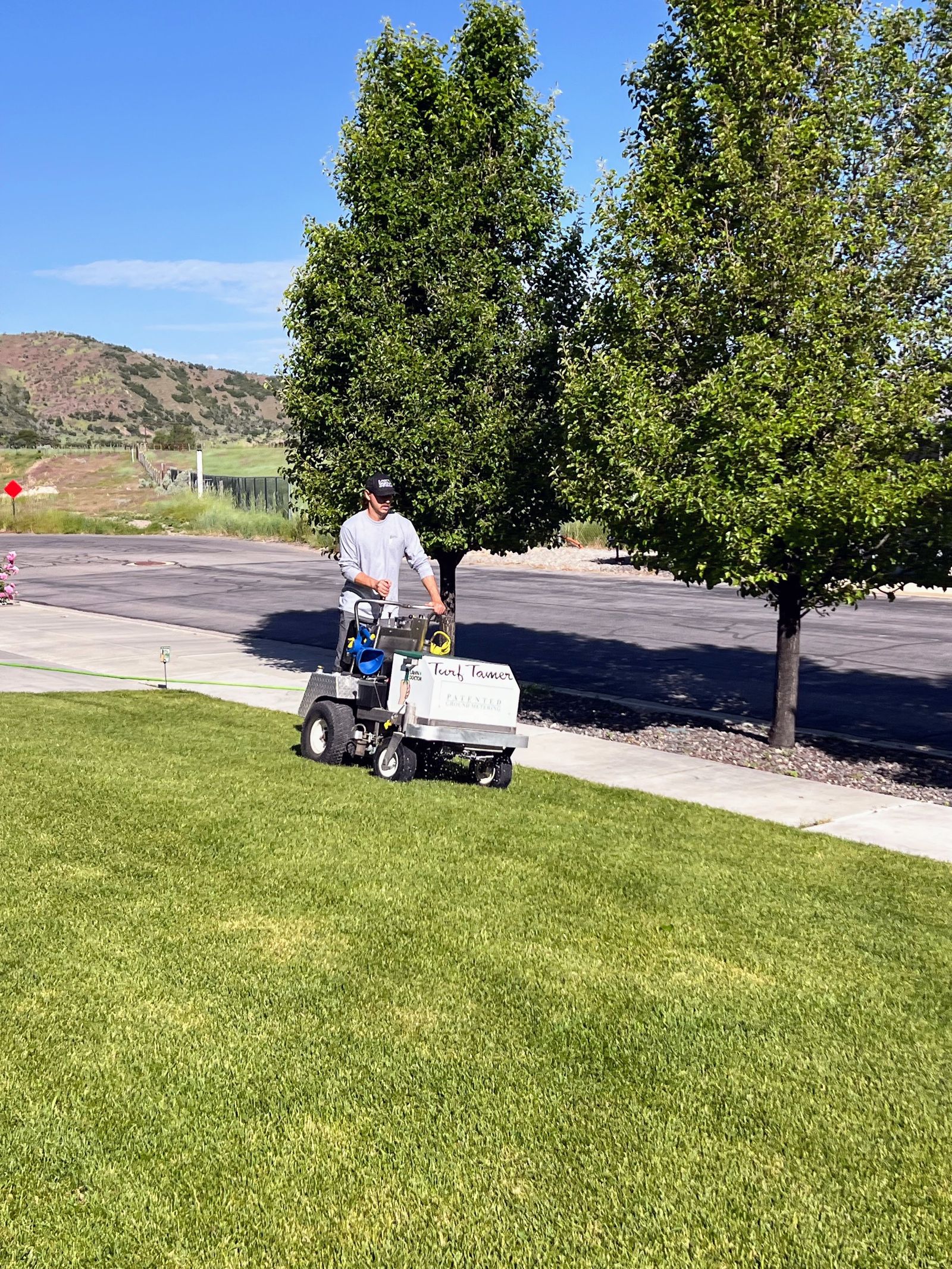
Lawns along the Wasatch Front and up in the Heber Valley fight a different battle than lawns in most of the country. Our soils are alkaline and heavy with clay, summers run hot and dry, winters are long, and the Utah County valley floor, the Heber Valley in Wasatch County and Park City in Summit County can be two or three weeks apart on the same calendar. A fertilizer bag from the hardware store does not know any of that. Our program does. Every one of the six visits is timed to what Kentucky bluegrass and fescue lawns in Provo, Orem, Spanish Fork, Heber City and Park City actually need that month, with the weed control built in rather than bolted on.
The result is a lawn that greens up earlier in spring, holds its color through July and August, and goes into winter thick enough to crowd out next year's weeds. Below is exactly what we do on each visit, why it is timed the way it is, what it costs, and what you can expect from us between visits.
The six-visit Lawn Maintainer program, round by round
Visits run every five to seven weeks from early spring to late fall. Six visits and seven services: the June visit is a double service, with the regular fertilizer and weed control application plus a preventive grub control application on the same day. Here is the season at a glance.
| Round | When (valley floor) | What we apply | What it does |
|---|---|---|---|
| 1 | Mid March to mid April | Pre-emergent plus a balanced spring fertilizer, broadleaf weed control as needed | Stops crabgrass and other summer annuals before they sprout, wakes the lawn up after winter |
| 2 | Late April to May | Second pre-emergent application plus fertilizer and broadleaf weed control | Extends the crabgrass barrier through the main germination window and knocks down dandelions and clover |
| 3 | June | Fertilizer and weed control, plus preventive grub control (billed as its own line) | Feeds the lawn before the heat and protects roots from grubs that hatch in July |
| 4 | July to early August | Heat-season fertilizer with weed control as needed | Keeps color without pushing soft growth that burns in 95 degree weather |
| 5 | Late August to September | Fall fertilizer plus weed control | Rebuilds the roots after summer stress, the most important feeding of the year for bluegrass |
| 6 | October to early November | Late fall fertilizer plus weed control | Stores nutrients for a fast green-up next spring and hits perennial weeds while they are pulling energy into their roots |
Heber City, Midway, Park City and Kamas run two to three weeks behind the valley on rounds one and two and a week or two ahead on round six. We schedule by elevation and soil temperature, not by the date on the calendar.
Grub control in round three is included for every program customer. It shows as its own line on the invoice because it is a separate product and a separate application, priced the same as a regular service, so the June visit bills as two services. You do not need to ask for it.
Why Utah County lawns need a different program
Alkaline, high pH soil
Most of the Wasatch Front sits on soil with a pH between 7.5 and 8.3. At that level iron and other micronutrients lock up and the grass cannot absorb them, which is why so many Utah lawns look pale yellow-green in midsummer even when they are being fertilized. Our fertilizer blends carry sulfur to work against the alkalinity, and we add iron when a lawn needs color without extra growth.
Clay that compacts and sheds water
Lake-bottom clay from Provo to Payson holds nutrients well but compacts hard and drains slowly. Fertilizer sitting on compacted clay runs off instead of reaching the roots. That is why we pair the program with aeration for lawns that need it, and why we tell you to water each treatment in by the next morning.
A short, intense growing season
Cool-season grasses do their real growing in April, May, September and October. June through August they are mostly trying to survive. A program that dumps nitrogen in July makes a lawn look good for ten days and then thin, disease-prone and thirsty. Ours feeds hardest in spring and fall and goes easy in the heat.
Weeds that love our conditions
Dandelion, clover, spurge and black medic thrive in thin, alkaline turf. Field bindweed (what most of us call morning glory) runs deep roots that shrug off a single spray. Crabgrass fills every bare spot by August. None of these are beaten with one visit, which is why the program is six.
Pre-emergent timing in Utah: the visit that matters most
Crabgrass seed germinates when soil temperature holds around 55 degrees for several days in a row. In Spanish Fork, Provo and Orem that usually lands between the last week of March and the second week of April. In Heber City it is typically late April. Apply pre-emergent too early and it wears off before the main flush. Apply it after the seed has sprouted and it does nothing at all.
We track soil temperature and schedule round one to land in that window. Round two in May extends the barrier through the second germination push and catches spurge and goosegrass, which sprout later than crabgrass. Two applications is the difference between a lawn with a few crabgrass clumps in August and a lawn with none.
- Round one pre-emergent needs about a half inch of water within a few days to activate. If your sprinklers are not on yet, a hose or spring rain works.
- Pre-emergent also blocks grass seed. If you plan to overseed, tell us and we will adjust the timing or skip the barrier in that area.
- Pre-emergent does not kill existing weeds. Broadleaf weeds that are already up get treated on the same visit with a separate product.
Weeds we control, and the ones that need a different plan
Broadleaf weeds are controlled with selective herbicides that kill the weed and leave the grass alone. On a typical Utah County lawn that means:
- Dandelion and clover, usually gone within two to three weeks of the first spring visit
- Spotted spurge and prostrate knotweed, the flat mat weeds that show up in July along driveways and thin spots
- Black medic, mallow (cheeseweed), purslane and plantain
- Field bindweed (morning glory), which takes repeated treatments through the season because of its root system. We hit it every visit it shows.
- Thistle, including Canada thistle, treated when actively growing
Grassy weeds are harder. Crabgrass and foxtail are stopped with pre-emergent and can be treated post-emergent while small. Orchard grass, quackgrass and tall fescue clumps cannot be sprayed selectively out of a bluegrass lawn with any product on the market. For those we talk about spot treatment and reseeding, or overseeding to crowd them out. We will tell you the truth about what a spray can and cannot do.
Weeds in driveway cracks, sidewalks, rock beds and along fence lines are not part of the lawn program. We treat those with our driveway and off-lawn weed control service, on its own or at a discount alongside the lawn program.
What a visit looks like
- The day before. The day before, you get a text and an email with the date, what we are applying, and a reminder to unlock gates, turn off sprinklers and keep pets inside during the visit.
- During the visit. Your technician applies the fertilizer with a calibrated spreader or sprayer and treats weeds across the whole lawn, not just the obvious patches. Most lawns take 15 to 30 minutes.
- What we notice. If the technician sees something you should know about, such as grub damage, a dry zone from a sprinkler problem, disease, or a pest issue, it goes in your visit report with a photo where it helps.
- After the visit. Within the hour you get an after-service email that lists exactly what was applied, the product and rate, and the aftercare steps. You can also see every visit in your customer portal.
- Aftercare. Aftercare is simple: water the treatment into the soil by the following morning, and keep kids and pets off the lawn until it is dry or watered in.
No contracts. You can pause, skip a round, or stop at any time. Most customers are on autopay and never think about it.
What lawn fertilization and weed control costs in Utah County
Pricing is by measured lawn area, not by guess. We measure your turf from aerial imagery and confirm it on the first visit, so you pay for the grass you actually have.
Lawn Maintainer services start at $67 per service for lawns under 3,000 square feet, and most residential lawns in Provo, Orem and Spanish Fork fall between $67 and $117 per service depending on size. Larger lots in Mapleton, Salem and the Heber Valley are priced by the thousand square feet. Every service in the program is the same price, including the grub control application in June, and prepaying the season saves 5 percent. These are 2026 rates.
Example: a 4,500 square foot lawn in Orem is $81 per service. Your quote is free, takes a few minutes, and comes with the exact measured price for your lawn before the first visit. We do not do pressure sales.
Add-ons that make the program work harder
Core aeration and overseeding in fall. Relieves the clay compaction and thatch that keep fertilizer from reaching roots. The single best thing you can add if your lawn is more than five years old.
Soil enrichment. Two applications a year that improve how clay holds water and nutrients, for lawns that stay thin no matter how much they are fed.
Hydra-Guard. A soil wetting treatment applied in early summer that helps water soak into clay instead of running off, so the lawn holds moisture through July and August on less irrigation. Ask about it when you get your quote.
Power seeding for bare or badly thinned areas where overseeding alone will not fill in.
Perimeter pest control, a separate six-visit service for ants, spiders, earwigs, wasps and boxelder bugs around the house.
Sprinkler blowout in October so the system that waters all this in does not crack over winter.
What to do between visits so the program pays off
We can feed and protect the lawn, but watering and mowing are yours, and they decide half the result.
- Water deep and less often: about an inch a week in spring and fall, up to an inch and a half in July and August, split into two or three early-morning cycles rather than a little every day. Clay needs the cycle-and-soak approach or the water runs off.
- Mow high. Three to three and a half inches shades the soil, keeps crabgrass seed from getting the light it needs, and grows deeper roots. Never remove more than a third of the blade at once.
- Keep the mower blade sharp. Torn blade tips brown over and invite disease.
- Leave the clippings. They return nitrogen to the soil and do not cause thatch on a healthy lawn.
- Tell us about dry spots, brown patches or bugs between visits. Reply to any of our texts or emails and we will look at it on the next visit or come sooner if it needs it.
Guaranteed results you can see
Every application is backed by the Lawn Doctor Satisfaction Guarantee. If weeds come back or you are not happy with a visit, tell us and we re-treat at no charge. If we still cannot fix it, we refund your last application. Certain restrictions apply.
We are a locally owned franchise based in Spanish Fork, licensed by the Utah Department of Agriculture (Pesticide Applicator License 4000-18448), and we have more than 160 five-star Google reviews from neighbors in Utah County and the Heber Valley.
Where we provide lawn fertilization and weed control
Utah County: Provo, Orem, Spanish Fork, Springville, Mapleton, Salem, Payson and Santaquin. Wasatch and Summit County: Heber City, Midway, Park City and Kamas. Each city page has local timing, soil notes and the pests we see there most.
Start with your city: Lawn care in Spanish Fork, Lawn care in Provo, Lawn care in Orem, Lawn care in Heber City, or see all areas served.
Fertilization and weed control questions
How many treatments does a Utah lawn need per year?
Six visits from March to November, five to seven weeks apart, and seven services, because the June visit is a double service with grub control added to the regular fertilizer and weed control application.
When should pre-emergent go down in Utah County?
When soil temperature holds near 55 degrees, usually late March to mid April in Provo, Orem and Spanish Fork, and late April in Heber City. We apply a second round in May to extend the barrier through the full crabgrass germination window.
Can I start mid-season?
Yes. We start at whatever round the calendar is on and prorate. Weeds already up get treated on the first visit; pre-emergent only helps if we start before mid May.
Is the treatment safe for kids and pets?
Products are applied at label rates by licensed technicians. Keep kids and pets off the lawn until it is dry or watered in, usually a few hours, and it is safe to use normally after that.
How soon will I see results?
Dandelions and clover curl within days and are gone in two to three weeks. Color improves within one to two weeks of a feeding. A badly neglected lawn takes a full season to turn around, and the second season is where it really shows.
Why do I still have weeds after the first visit?
A single visit cannot kill weed seed that has not sprouted yet, and deep-rooted weeds like bindweed take repeated treatments. If a weed we treated is still thriving three weeks later, tell us and we re-treat free under the guarantee.
Do I need to be home?
No. We need gate access and sprinklers off. You get a text the day before and an email with the full report after.
What is the difference between your program and TruGreen or a national company?
We are one local branch with our own technicians, our own phone number, and an owner you can reach. Timing is set for Utah County and Heber Valley specifically, products are chosen for alkaline soil, and there is no contract or auto-renew to cancel.
How much does lawn fertilization cost in Utah County?
It depends on measured lawn size. 2026 rates start at $67 per service for lawns under 3,000 square feet, and most residential lawns are between $67 and $117 per service. Grub control in June is the same price as a regular service. Prepaying the season saves 5 percent. We measure your lawn and give you an exact price before the first visit.
Do I have to sign a contract?
No. Pay as you go, pause or cancel any time. Prepaying the season is optional and saves money.
Areas served
Pick your city to see what we offer near you.
Weed control beyond the lawn
Weeds also grow in driveway cracks, sidewalk joints, and rock beds. We spray those too, on their own or at a discount with our Lawn Maintainer program.
See driveway and off-lawn weed controlRelated reading
Timing, how-to and what to expect, written for Utah County and Heber Valley.
Get a free quote
Free evaluation, no contracts, pay as you go. Call or text (385) 463-2430 or request a quote online.