
Lawn Aeration & Overseeding in Utah County & Heber Valley
Core aeration pulls thousands of small soil plugs out of the lawn so water, air and fertilizer can reach the roots through Utah's compacted clay. Overseeding on the same visit drops fresh seed into those holes to thicken thin turf and crowd out weeds. We offer aeration on its own or aeration with overseeding, priced by measured lawn size, across Utah County, the Heber Valley and Park City. Fall, late August through October, is the best window and spring is second best.
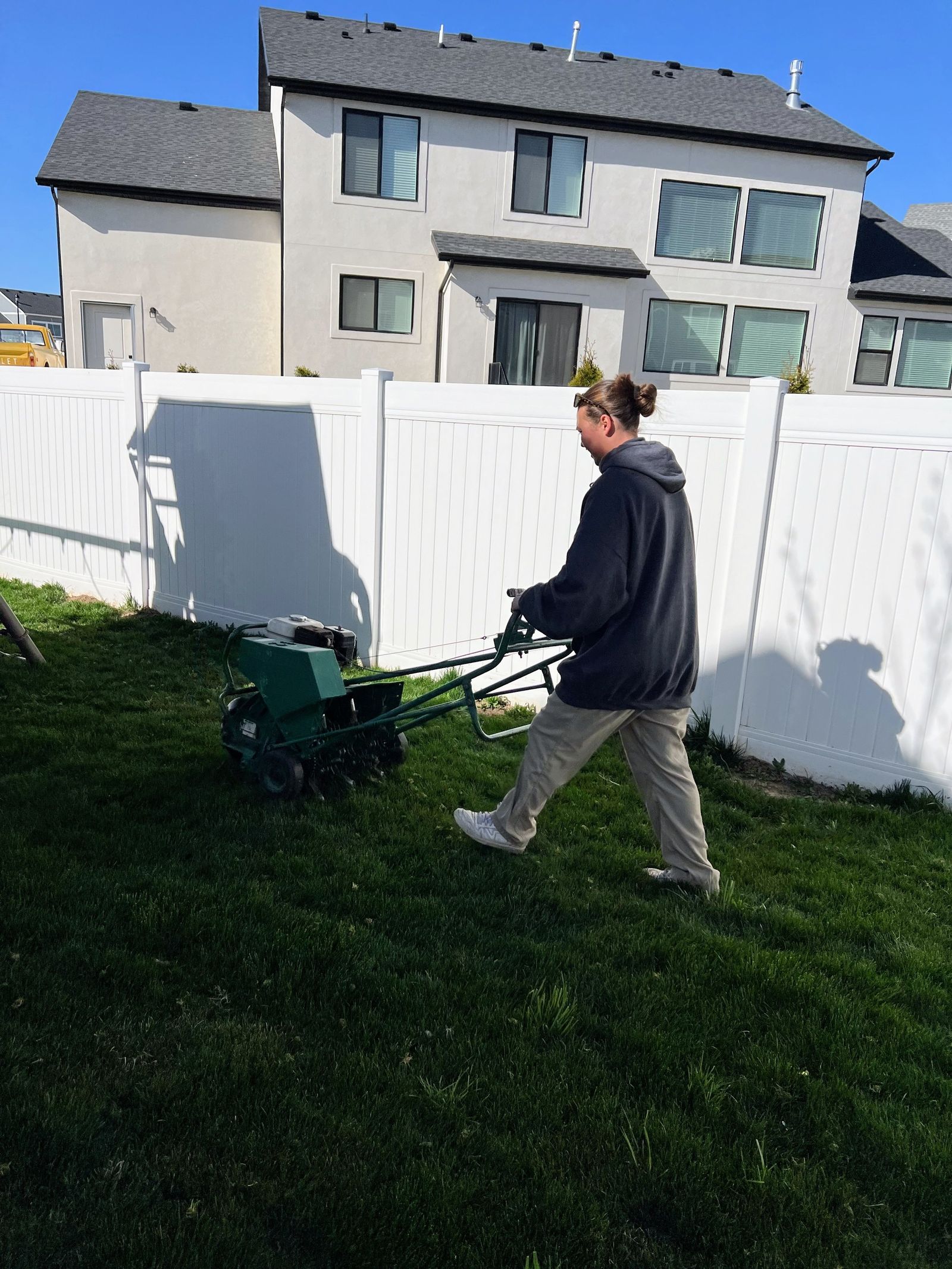
Most of Utah County sits on old lake-bottom clay. It grows good grass when it is open, and it turns into something close to brick when it is not. Kids, dogs, mowers, foot traffic and a few years of irrigation pack it down until roots stop growing, water sheds off the top, and the fertilizer you pay for never gets below the first half inch. The lawn thins, weeds move into the gaps, and more water and more fertilizer do not help because they cannot get in.
Core aeration is the fix, and it is the single most effective thing you can do for a Utah lawn that is more than a few years old. Overseeding right after it is how you turn a thin lawn into a thick one without tearing it out. This page covers how we do both, when to do it where you live, what it costs, and what to expect in the weeks after.
What core aeration does for a Utah lawn
Our aerator pulls plugs of soil about half an inch wide and two to three inches deep, every few inches across the whole lawn. The plugs stay on the surface and break down in a week or two. The holes do the work:
- Water goes in instead of running off. which matters on sloped lots and anywhere water pools or runs onto the sidewalk during a sprinkler cycle.
- Roots grow deeper. into soil that now has air in it. Deeper roots mean a lawn that holds color through July and needs less water to do it.
- Fertilizer reaches the root zone. so every treatment in the Lawn Maintainer program works harder for the rest of the season.
- Thatch breaks down. because the soil microbes that eat it finally get oxygen. Lawns with more than a half inch of spongy thatch benefit most.
- Seed has somewhere to go. which is why overseeding on the same visit works so much better than throwing seed on hard ground.
We use core (plug) aeration, not spike aeration. Spike machines and spiked shoes push soil sideways and make compaction worse around every hole. Pulling the plug out is the only method that actually relieves pressure in clay.
Overseeding: how a thin lawn gets thick again
Overseeding spreads fresh seed across the existing lawn right after aeration, while the holes are open. Seed that lands in a plug hole has soil contact, moisture and protection from birds and sun, which is exactly what seed thrown on top of a lawn does not have. The result is new grass plants growing between the old ones, so the lawn fills in from inside rather than from patches.
We seed with cool-season blends suited to the Wasatch Front: Kentucky bluegrass and turf-type tall fescue, with perennial ryegrass for fast cover. Bluegrass spreads on its own once established, which is why a lawn overseeded two falls in a row usually stays thick on its own after that.
When you need more than overseeding
Overseeding works on a lawn that is thin, not one that is mostly gone. If more than about a third of an area is bare, or if the problem is a dead patch from grubs, dog spots or a sprinkler that was off all summer, power seeding puts seed directly into the soil in rows and gives you a full stand in one season. We will tell you which one your lawn needs when we measure it.
When to aerate and overseed in Utah County and the Heber Valley
Timing is the whole game. Cool-season grass grows roots hardest when air temperatures are in the 60s and 70s and soil is still warm, which in our area means fall first and spring second.
| Area | Best window (aeration and overseed) | Second window | Why |
|---|---|---|---|
| Provo, Orem, Spanish Fork, Springville, Mapleton | Late August to mid October | April to mid May | Warm soil, cool air, fewer weed seeds germinating, 6 to 8 weeks before the first hard freeze |
| Salem, Payson, Santaquin | Late August to early October | April to mid May | Slightly earlier freeze on the south end of the valley |
| Heber City, Midway | Mid August to late September | May | Short season; seed needs to be up before late September frosts |
| Park City, Kamas | Early August to mid September | Late May to June | Shortest season in our service area; fall seeding must be early |
Fall is better than spring for overseeding because new grass gets a full fall and the following spring to root before its first summer, and because spring pre-emergent from the Lawn Maintainer program will block new seed. If you want spring seeding, tell us and we adjust the pre-emergent timing in that area.
Aeration on its own can be done in spring or fall. Both help; fall pairs better with seed.
What an aeration and overseed visit looks like
- Before we come. we text and email you the day before. Water the lawn well the day before so the tines pull full plugs (dry clay chips instead of coring). Mark sprinkler heads, valve boxes, invisible dog fence wire and shallow cable with flags. Mow a little shorter than usual, two to two and a half inches. Unlock gates, pets inside.
- The visit. takes 30 to 90 minutes depending on lawn size. We aerate in two directions on most lawns, then spread seed at the right rate for the blend, then leave the plugs on the surface. A fall fertilizer or starter fertilizer on the same visit is included in many programs and gets the seed going.
- After we leave. you get the service report by email with watering instructions. The plugs look messy for about a week and then disappear into the lawn. Do not rake them off.
Watering and mowing after overseeding: the two weeks that decide the result
We can put the seed in the ground. Keeping it alive for the first three weeks is yours, and it is the difference between a thick lawn and a wasted visit.
- Days 1 to 14. keep the top half inch of soil damp at all times. That usually means two or three short cycles a day (5 to 10 minutes a zone, morning and early afternoon), not one long one. Seed that dries out after it sprouts dies.
- Days 14 to 28. once the new grass is an inch tall, drop to once a day, then every other day, and lengthen each cycle so water goes deeper.
- Mowing. wait until the new grass is three inches tall before the first mow, then mow high. Bag clippings the first two mows so they do not smother seedlings.
- Weed control. no broadleaf herbicide on the new grass for about six weeks. We schedule around it.
- Traffic. keep kids, dogs and furniture off the seeded areas as much as you can for three weeks.
- Sprinkler blowout. in the Heber Valley and Park City, fall seeding and blowout season overlap. We sequence them so the seed gets its water before the system is shut down.
What aeration and overseeding costs in Utah County
Both services are priced by measured lawn size, the same as everything else we do. Core aeration on its own is the lower-cost option; aeration with overseeding adds the seed and is the one most lawns need. Program customers get the best price when it is added to their Lawn Maintainer season, and prepaying the season saves 5 percent. We measure your lawn and give you the exact price before we schedule.
How often should a Utah lawn be aerated?
Once a year for most lawns in Utah County, in the fall. Lawns on heavy clay, lawns with heavy traffic (kids, dogs, a trampoline) and lawns that drain poorly benefit from spring and fall. A new sod lawn should be aerated starting its second fall, because sod comes with a thatch layer and sits on top of soil that was compacted during construction.
Overseeding every fall for two or three years turns a thin lawn into a thick one. After that, many customers overseed every second or third year to keep it there.
What to pair it with
Soil enrichment improves the structure of the clay over time so the benefit of aeration lasts longer. Hydra-Guard helps water get into and stay in the root zone through summer, and the combination of fall aeration and spring Hydra-Guard is the best one-two for a lawn that struggles every July. Grub control protects the new roots from the grubs that hatch in midsummer.
Our seed guarantee
If your overseeding does not fill in the way it should, and you followed the watering instructions, we add more seed the following season at no charge. Aeration on its own is not covered by the guarantee because the result depends on watering, mowing, weather and soil, but we leave clear guidance after every visit. Everything else we do is backed by the Lawn Doctor Satisfaction Guarantee.
We are locally owned in Spanish Fork and have more than 160 five-star Google reviews from Utah County and Heber Valley homeowners.
Where we aerate and overseed
Provo, Orem, Spanish Fork, Springville, Mapleton, Salem, Payson and Santaquin in Utah County; Heber City and Midway in the Heber Valley; Park City and Kamas in Summit County. Start with your city: Lawn care in Spanish Fork, Lawn care in Provo, Lawn care in Orem, Lawn care in Heber City, or see all areas served.
Aeration and overseeding questions
When is the best time to aerate a lawn in Utah?
Fall. Late August through mid October on the valley floor, and mid August through late September in Heber City, Midway and Park City. Spring (April to mid May) is the second-best window. Fall is better for overseeding because new grass gets a full fall and spring to root before its first summer.
Should I aerate before or after overseeding?
Aerate first, then seed on the same visit while the holes are open. Seed that lands in the plug holes has soil contact and moisture; seed thrown on hard ground mostly feeds the birds.
How long does it take to see results?
New grass from overseeding sprouts in 7 to 21 days depending on the blend and temperature, and fills in over 6 to 8 weeks. The benefit of aeration shows up as better color and less stress the following summer.
Should I dethatch my lawn instead?
We do not recommend dethatching for Utah lawns and we do not offer it. Power raking tears out living grass along with the thatch and leaves the lawn thin going into summer. Core aeration solves the same problem without the damage: the plug holes let oxygen reach the soil microbes that break thatch down, and the plugs themselves top-dress the lawn with soil that speeds decomposition. A lawn aerated every fall rarely builds more than a half inch of thatch, which is a healthy amount.
Do I need to rake up the plugs?
No. They break down within a week or two and return organic matter and nutrients to the lawn. Mowing over them speeds it up.
Can I aerate a new sod lawn?
Starting its second fall, yes, and you should. Sod sits on soil that was compacted during construction and brings its own thatch layer.
Will aeration damage my sprinkler system?
Not if heads and valve boxes are marked. We flag what we can see, and we ask you to flag heads, valve boxes and any shallow wire (invisible dog fence, low-voltage lighting) before we arrive.
How much does aeration cost in Utah County?
It depends on measured lawn size. Aeration alone costs less than aeration with overseeding. We measure your lawn and quote an exact price before scheduling, and program customers get the best rate.
What if the seed does not come up?
If you followed the watering instructions and the overseeding did not fill in, we add more seed the following season at no charge.
Is spike aeration the same thing?
No. Spike aeration and aerator shoes push soil sideways and increase compaction around each hole. Core aeration removes a plug, which is the only way to relieve compaction in clay.
Areas served
Pick your city to see what we offer near you.
Related reading
Timing, how-to and what to expect, written for Utah County and Heber Valley.
Get a free quote
Free evaluation, no contracts, pay as you go. Call or text (385) 463-2430 or request a quote online.