
Missed the Sprinkler Blowout? What to Do Now in Utah County
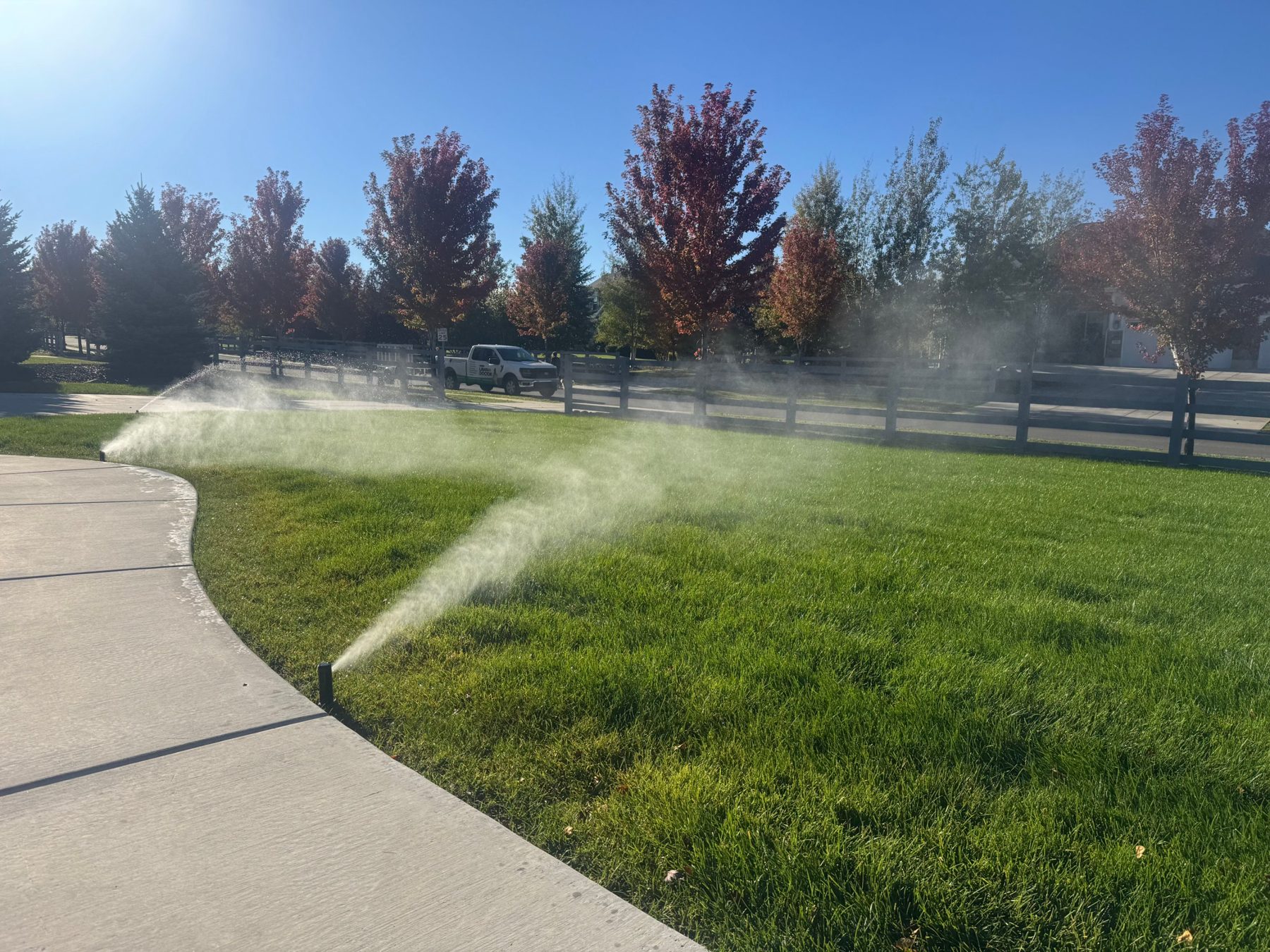
The first freeze has come and gone and the system is still charged. Here is what actually breaks, what you can do yourself tonight, and when a late blowout is still worth it.
Every November we get the same call: the first hard freeze already happened, the system never got blown out, and the homeowner wants to know how bad it is. The honest answer is that it depends on three things: how cold it got, how long it stayed there, and where the water in your system is sitting. Here is how to think about it and what to do today.
What actually breaks, and when
Water expands about 9 percent when it freezes. In a sprinkler line that is mostly empty that is harmless. In a line that is full, with nowhere for the expansion to go, it splits the pipe or cracks a fitting. The parts that fail first are the ones above ground or closest to it: the backflow preventer by the house, the valve manifold, and any pipe in the top six inches of soil. Lateral lines deeper than that usually survive one or two light freezes because the ground is still warm in late October.
On the valley floor, a single night at 28 degrees in late October rarely cracks anything buried; it is the week of 20 degree nights in mid November that does the damage. In the Heber Valley and Park City those nights come three weeks earlier, which is why we start Heber blowouts in late September.
What to do tonight
- Shut off the water to the irrigation system. at the main irrigation shutoff, usually a valve in the basement, garage or a box near the meter. This stops the system from refilling and takes pressure off the backflow.
- Open the drains on the backflow preventer. the two small test cocks and the ball valves, set to a 45 degree angle so trapped water can escape. Wrap the backflow in an old towel and a plastic bag if a hard freeze is forecast tonight.
- Open any manual drain valves. at the low points of the system if yours has them. Older Utah County systems often do; newer ones often do not.
- Do not run the system. to try to push water out. Running a charged system on a freezing night makes it worse.
These steps drain the parts most likely to crack. They do not empty the lateral lines, which is what a compressed-air blowout does.
Is a late blowout still worth it?
Yes, in almost every case through November. Even after a few light freezes, the water that breaks lines is the water still sitting in them, and a blowout removes it before the deep cold in December. If a fitting has already cracked, the blowout is also how it gets found: air escaping from a split line is obvious, and it is cheaper to know now than to discover a geyser in April. We keep blowing out systems in Utah County through November and in Heber until the ground freezes.
What a blowout involves
We connect a compressor to the system, open each zone in turn and push the water out through the heads with controlled air pressure, then shut down the controller and leave the backflow valves set for winter. Most residential systems take under 30 minutes. In spring, if anything was damaged over the winter, our sprinkler check finds it before the season starts.
Next year
Put it on the calendar now: mid to late October on the valley floor, late September to mid October in the Heber Valley. Program customers can ask us to add the blowout to the schedule so it is never a question again. The 2027 season schedule has every window in one place.
Need help with your lawn or home?
Utah County, Heber Valley, and Park City
Pick your city to see what we offer near you.
Related guides and services
Want help with this? Start here.
Lawn fertilization and weed controlSprinkler blowouts and winterizationLawn care and pest control in Heber CityLawn care and pest control in KamasReady for a greener lawn?
Call us or request a free quote. We make it easy.